Showing posts with label Best Charlotte Moving Company. Show all posts

Friday, November 1, 2019

Home Storage: A How-To Guide to Help Keep You Organized and Clutter-Free


The importance of staying organized is never more apparent than when you are packing, unpacking, or simply going through a purge. Having a place for everything, and then keeping those places organized and free of clutter, can be cumbersome and a bit overwhelming, but at TNT Moving Systems we have a few tricks to help you keep everything in its right place.

No matter the size of the home, we always find a way to fill it with stuff. It accumulates rather quickly, this stuff: that comfy chair you were given but don't really need; excess clothing items you're just not ready to get rid of (what if boot-leg jeans come back into style?); a garage full of lumber for, you know, that treehouse you have been planning on building for the kids—who just left for college.

It’s difficult to get rid of stuff, even when we know we need to do it. But worry not, we are here to help. And the first step in becoming clutter-free is not to look at how much you have, but instead to figure the what and where.

What to Keep & Where to Store it

Before we look into how to store specific items, you need to decide where you will store them. Obviously, dishes and the like go in the kitchen, the sofa and television in the living room, etc. But what about those things you want to keep, but you don't use all the time?

The first step in organizing your home is to figure out how you are going to work with the space you have. And no matter the size of your home, it’s best to begin with the rule of three. Decide on the three areas of your home that will be most used to store lesser-used items. Typically, these areas include the basement, garage/shed, and attic. Here are some general rules for using each of these three areas for storage:

Basement: for some reason, people love to put boxes and perishables in their basements. This is usually not a good idea because the basement of any house is the first place to flood. Basements are also a bit more humid than the rest of the house, which encourages mold to grow. Now, just because basements tend to take in moisture it doesn’t mean you can’t use this area for storage, you just need to be thoughtful about what you put down there. At TNT Moving Systems, we recommend using a basement to store the following only:
  • Plastic furniture (outdoor, children's, etc.)
  • Unused toys
  • Kitchen supplies that are sealed and kept in glass or plastic containers

Garage/Shed: whether or not your garage or shed is insulated, this is a good place to store anything that can withstand extreme hot and cold weather. And even though people like to store food items in the garage, especially when the garage and kitchen are connected or close, this is not a good idea. Insects, reptiles, and even rodents, always find a way in and out, and you don’t want to have anything around that could attract them. However, these things are fine to be stored in a garage or shed:
  • Tools
  • Outdoor equipment
  • Clothing (in sealed bags or containers to keep away from moths and other insects)
  • Holiday décor

Attic: unless it is temperature-controlled, an attic can get pretty hot or cool—but not near as much as your garage. This area of the house is the most used for storage, and the biggest problem with using the attic is we usually forget what we put up there! Here are items to be stored way upstairs:
  • Decorations
  • Suitcases and other luggage items
  • Fabrics and furniture
  • Miscellaneous items that don’t seem to fit anywhere else in the house

Now that you have those storage items put away, let’s jump into the fun stuff like organizing the refrigerator, silverware drawer, and cabinet area. The very thought of going through these places and purging and organizing induces sweat and calls up that vein protruding from your forehead—but don’t stress! We got you.

The Kitchen

A well-organized kitchen provides more than just food and drink. It creates a warm and welcoming area for conversation and cooking—a place to explore new ideas and establish traditions. And because we use our kitchens so much (at least three times a day, but of course it’s much more than that), we find that the level of organization in which our kitchen is kept, strongly determines how organized we are in our own lives; a dirty, unkempt kitchen makes us feel discombobulated, out of place. But a clean, kept kitchen makes us calm and happy, ready to try new things.

When we are organized we feel good. We feel right, like we can do anything. So let’s look at organizing three separate areas within the kitchen: the fridge, the silverware drawer, and the upper cabinets (used for housing dishes).
  • The Fridge: an organized fridge can save you money and time. The first step is to clean out and discard. This means getting rid of those items past their expiration dates (you know you have a jar of pickles sitting in your refrigerator from 2012), and also throwing out those products you know you are never going to use.

The second step is to reorganize the shelves within the fridge. Reconfigure the shelves so that you are able to have the items most used in the front or inside the door. You want everything placed in order of use. This keeps you from having to dig through areas of the fridge for one little thing, which then tips over the milk carton initializing a domino-like collapse of everything else on that shelf.

Next, find a heavy-duty and water-resistant shelf liner (The Container Store makes these specifically for inside the fridge) and line the bottom of all shelving areas. This will make cleanup from rotten fruit or spills much easier. What’s more, if the spillage is too drastic you can remove the liners and wash them.

Now it’s time to fill the fridge back up. Be sure and keep all similar items together—for example mustard, ketchup, and salad dressing can all go together. Consider purchasing small organization bins meant for a fridge (you can find these at The Container Store as well) where items can easily be kept together.

Stack to save space. Certain items, like fruit containers and jars, can be stacked pretty easily, but what about cans or bottles? These are likely to take up the most space because they are so difficult—if not impossible—to stack. But rest assured, there is a way. We love the bottle and can dispenser from…wait for it…The Container Store, which is a small, flat piece of plastic with ridges that keep individual bottles and cans in place and stackable. This is a wonderful way to save space in the fridge.
  • The Silverware: it takes all of five seconds for the silverware drawer to become disorganized. Now you and the rest of your family find yourselves rummaging around in it with one hand, creating that always-recognizable song of silverware clinking and chiming like nails running down a chalkboard. And all this just to find a fork. But it doesn’t have to be like this. This is a small organization project that delivers big results.

Begin by taking everything out of the drawer(s) and setting them in groups (spoons with spoons, forks with forks, you get it). Now, go through each group and try and remember the last time that item type was used. If you can’t remember, throw it out!

Next, measure the interior of the drawer and buy a durable liner to place inside (you can find quality liners at Target, The Container Store, even Walmart).

Once the drawer is lined, purchase individual silverware organizers (The Container Store has these made of wood and we find they work well and look the best). The problem with those one-piece plastic organizers is you are stuck with one design. What happens when you add more silverware or need to reconfigure? This is what's so nice about using individual boxes. Now you can set your silverware drawer up just as you like it. And if you need to add a section for new silverware, just buy another organizer.
  • The Cabinets: the upper cabinets are typically reserved for dishes. This area is also one that becomes cluttered quickly, but with a few organization hacks, you can have the cleanest, most organized cabinets in the neighborhood.

Start by taking all the dishes out and placing them somewhere safe. Then measure and place a liner down—be sure to use one with rubber or any other non-slip surface so you know your dishes will stay in place, even when bumped or pushed.

Now, in order to take advantage of all your vertical space, consider using Undershelf brackets and hooks for those wasted spaces above your stacked plates and bowls. Undershelf brackets are perfect for small mugs and saucers because they act as mini shelving areas that attach to the underside (with small screws) of the interior of the cabinet. And hooks can be used for more mugs or anything else with a handle.

Another way to add storage room is by utilizing stackable shelves. By simply placing a stackable shelf inside of your cabinet you can create even more room to stack plates and bowls. It’s a shelf within a shelf and it’s genius!

Organized: A Way of Life

Becoming organized takes some work. For instance, cleaning out and reorganizing a fridge can take up to a day to complete. Working on your silverware drawer and cabinets might not take quite as long, but it’s still a lot of work. But here’s the thing: once you are organized, it’s really not that difficult to remain that way.

Think of it as a way of life, and you will quickly begin to notice the benefits of being organized because life is better when your home is well put together.

Feel free to contact us at TNT Moving Systems for more organization ideas—what about your dining room or play areas? We're here to help!


-Andrae Bergeron

*Source: https://www.containerstore.com/organization-projects?search=kitchen&page=1#stq=kitchen&stp=1

Friday, March 1, 2019

Is Minimalism the New Black?

Although so much of the “American Dream” has involved acquiring things, the “tidying up” trend has taken over. No longer is a growing mass of possessions — clothes, gadgets, collections — indicative of social standing. Instead minimalism is the new luxury.

WHO IS “MINIMALISM” FOR?
Good design isn’t cheap. Whether it’s an iPhone or an angora sweater, a KitchenAid mixer, or boots made from hand-tooled leather, items that are built to last require an investment.
There’s a certain kind of circular disadvantage associated with poverty and consumerism. Limited incomes typically allow little room for saving money. If one is unable to afford “The Nice Thing” because one does not have the upfront capital to buy it, one often has to settle for the less expensive, poorly made “Available Thing.” Instead of buying “The Nice Thing” once, one ends up perhaps spending even more over time repeatedly buying the “Available Thing.”
Consider an inexpensive pair of work slacks sold at a big-box discount store versus a pair of tailored slacks in heavier fabric from a high-end retailer. Or think about a cheap set of socket wrenches made from low-grade metal that warp when put to the test versus professional-grade tools that will withstand any pressure. The same exchange applies to buying in bulk. That giant pack of paper towels costs $22 while one roll is $1.50. (And buying that multi-pack means needing space to store it.) Saving money in the long run requires having money to spend now.
“You cannot choose to ‘declutter’ if you are already living in a sparse home you cannot afford to furnish,” writes Chelsea Fagan for The Financial Diet. “You cannot ‘reduce’ the food you consume if you are already only able to put one good meal on the table per day. And when nearly half of Americans would be unable to pay their bills if they missed a single check, this ‘forced minimalism’ is much, much more common than we would like to imagine.”
Being a “minimalist” in the Pinterest sense of clean, white shelves and tiny stereo speakers on a natural wood entertainment center in an airy living room with a stylish couch and hypoallergenic cat isn’t a casual lifestyle.
“The only people who can ‘practice’ minimalism in any meaningful way are people upon whom it isn’t forced by financial or logistical circumstances,” Fagan writes.
TIDYING UP
Although not everyone can afford Instagram-worthy décor, and while cleaning and organizing take time that may well be hard to find, there are practical tips to managing messes.
Marie Kondo, author of “The Life-Changing Magic of Tidying Up: The Japanese Art of Decluttering and Organizing,” asks one question that cuts to the heart of clutter — does it bring you joy?
Granted some items in our lives are simply necessary. Our toothbrush may not make us happy, but it helps keep us healthy. What Kondo is getting at though are the things we amass that don’t quite work, don’t quite fit, are taking up space that we otherwise need, and are distracting from the things we actually do want.
Do you have 16 pairs of shoes and only wear 3? Kondo says to thank those 13 extra pairs for having served their purpose for you and release them on to their next life by donating, selling, or trashing them. Are you pretending you’re going to re-read that college textbook about international banking systems? Kondo says, let it go. Did your grandmother buy you a set of seasonal toilet paper cozies at the church yard sale that you’ve kept shoved in the back of the sock drawer? Kondo tells you it’s okay to send them on their way.
Tidying up, which you can see in action in Kondo’s Netflix series, is an exercise in self-editing. “Her method is deceptively simple,” writes Sarah Archer in The Atlantic. “She has clients begin with clothing, move on to books, then paper documents, then komono, which means ‘miscellaneous’ in Japanese and encompasses the kitchen, bathroom, garage, and other objects. Then they finish up with the final category, which is sentimental items. There’s something about the way in which Kondo explains the goals of her exercises that gets her clients to open up. This is the key difference between Tidying Up and most other reality shows: There’s no sense of competition, and the ostensible makeover at the heart of every episode simply involves regular people becoming happier and more at ease in their own home. Kondo doesn’t scold, shame, or criticize. Things spark joy or they don’t, and it’s fine either way.”
Decluttering has the advantage of making it easier to clean. Whether mopping floors or disinfecting the bathroom counters, things get in the way. Although Kondo is in favor of organizing, not by area but by type of thing (i.e. not just the hall closet and winter wear but all your clothing all at once), you may try tackling a smaller task at first to get you motivated. Try going through the refrigerator and freezer by taking everything out, inspecting expiration dates, and cleaning all the hard surfaces with a disinfecting cleaner. This activity has the added benefit of keeping your family healthy! How about the coffee table or nightstand? Tackling little projects that take less of a time commitment than your entire closet will help keep you going and give you a way to practice new behaviors like putting things away after you’re done using them.
If you’re looking to save money, making your own cleaning supplies is easier than you might think. For an all-purpose cleaner that’s also safe around children and animals, combine 4 tablespoons baking soda and 1 quart warm water, and use it with a sponge to wipe messes away. Make a glass cleaner by mixing 1/2 cup white vinegar with 1/4 cup rubbing alcohol and 2 cups of water. Remember that baking soda is a terrific deodorizer for sneakers, gym bags, and pet beds. For greasy surfaces like kitchen cabinets, add a few drops of dish soap to a spray bottle and fill it with warm water and clean with a damp rag. If you need to scrub something like a pan or bathtub, try a handful of salt and use half a lemon to rub the salt around then rinse with clean water.

Other quick tips to refresh your surroundings?
  • Put your houseplants in the shower. A full rinse with cool water will clear them of dust and debris.
  • Run plastic children’s toys through the dishwasher to sanitize them.
  • Wash your shower curtain in the washing machine with hot water and a few towels.

TOO MUCH
Organizing in and of itself is nothing new. Television capitalized on homemakers’ aspirations for a clutter-free life in the early 2000s, launching series of reality TV shows like “Hoarders,” “Clean Sweep,” and “Mission: Organization.”
“Hoarders” stood out for the extreme cases the show highlighted. Homes were more than disorganized or cluttered. Occupants had crossed a line such that their attachment to and inability to get rid of possessions, many of which were no longer useful and had become hazardous, posed a serious threat to their quality of life. Commonly hoarded items include newspapers, magazines, bags, boxes, photographs, household supplies, food, and clothing.
“Hoarding can be related to compulsive buying (such as never passing up a bargain), the compulsive acquisition of free items (such as collecting flyers), or the compulsive search for perfect or unique items (which may not appear to others as unique, such as an old container),” according to the Anxiety and Depression Association of America.
Hoarding has been classified as a mental condition closely associated with obsessive-compulsive personality disorder (OCPD), obsessive-compulsive disorder (OCD), attention-deficit/hyperactivity disorder (ADHD), and depression. The ADAA states:
“People hoard because they believe that an item will be useful or valuable in the future. Or they feel it has sentimental value, is unique and irreplaceable, or too big a bargain to throw away. They may also consider an item a reminder that will jog their memory, thinking that without it they won’t remember an important person or event. Or because they can’t decide where something belongs, it’s better just to keep it.”
There’s a difference between what is seen as typical saving versus collection and hoarding. Those who hoard often feel embarrased about their possessions and living conditions when others see them. Their clutter is an isolating force. Collectors on the other hand maintain their carefully curated collections and have a sense of pride in what they have gathered.
Someone who hoards may exhibit the following:
  • Inability to throw away possessions
  • Severe anxiety when attempting to discard items
  • Great difficulty categorizing or organizing possessions
  • Indecision about what to keep or where to put things
  • Distress, such as feeling overwhelmed or embarrassed by possessions
  • Suspicion of other people touching items
  • Obsessive thoughts and actions: fear of running out of an item or of needing it in the future; checking the trash for accidentally discarded objects
  • Functional impairments, including loss of living space, social isolation, family or marital discord, financial difficulties, health hazards
The show “Hoarders” and its follow up, “Hoarding: Buried Alive,” made an attempt to help those who hoard address their conditions with professional organizers and mental health therapists. These types of professionals target the behaviors associated with hoarding rather than just the mess itself.
The National Association of Productivity and Organizing Professionals has tips for how to hire a professional organizer or productivity consultant. Step one is figuring out what kind of services are needed — there’s not a one-size-fits-all approach to tidying up! There are consultants who specialize in a range of skills such as organizing for people with disabilities, helping seniors who are downsizing, managing estate sales, tackling home offices, converting paper documents into digital assets, and designing storage solutions such as customized closets.
“Avoid choosing a Professional Organizer or Productivity Consultant strictly by price,” states NAPO guidelines. “Instead, focus on finding someone with the personality and skill set that match your needs. That person is most likely to deliver the greatest value by achieving the results you desire in the shortest amount of time.”

WHEN IT COMES TO MOVING
How much we have seems to directly correlate with how long we’ve been in a single place. Maybe there’s still a stash of your childhood things in your parents’ basement. Maybe the garden shed in the backyard is a vestige of every hobby you ever had. Whether you ever plan to move or not, pretend that you are. How hard would it be? How much money would you spend putting things in storage or shipping things by weight?
TNT Moving Systems can get you from wherever you are to wherever you’re going, local and long-distance, but we know from experience that planning ahead for moving day is a good thing. If you need help, call us for a free quote. We are a moving company but we also tackle projects like loading and unloading storage pods, moving pianos, and packing.

Visit us online at tntmovingsystems.com or call 704.523.1455.

Monday, January 28, 2019

Tidying Up - How To Make 2019 Your Year

Did you make a host of resolutions when the calendar changed from December 31 to January 1st?

Most of us make a resolution or vow to break bad habits (and create new ones), but not all of us see them through to the end of the year. It happens!

The good news is, we’ve compiled some suggestions so that the new year is nothing but smooth moving for you.

10 ideas to help you navigate 2019 and come out ahead!

Exercise and physical activity are a great way to feel better, boost your health, and have fun. For most healthy adults, the Department of Health and Human Services recommends at least 150 minutes a week of moderate aerobic activity or 75 minutes a week of vigorous aerobic activity a week, or a combination of moderate and vigorous activity. Examples include running, walking, or swimming. Fit in strength training for all the major muscle groups at least twice a week by lifting free weights, using weight machines, or doing body-weight exercises.

Space out your activities throughout the week. If you want to lose weight, meet specific fitness goals or have even more benefits, you may need to increase your physical activity time.

Remember to check with your doctor before starting a new exercise program, especially if you haven’t exercised for a long time, have chronic health problems, such as heart disease, diabetes or arthritis, or you have any concerns.*
TNT Moving Systems, New Year Resolutions, Organization, Tidying Up
Going on a diet is usually high on the list of resolutions, but it might be easier to make your diet healthier for starters. These tips from the Mayo Clinic might help:*

  • Do you want to adopt a healthy diet but aren’t sure where to start? As you consider the parade of healthy diets in magazines and cookbooks, make sure to look for one that:
  • Includes a variety of foods from the major food groups: fruits; vegetables; whole grains; low-fat dairy products and lean protein, including beans and other legumes, nuts and seeds; and healthy fats
  • Provides guidelines for how much food to choose from each group
  • Includes foods you can find in your local grocery store, rather than specialty or gourmet store items
  • Fits your tastes, lifestyle, and budget

Also consider your health risks. For example, do you have high cholesterol or high blood pressure? If so, be sure to follow a diet that’s low in salt, saturated fat and cholesterol, and high in fruits, vegetables, whole grains and healthy fats. For personalized advice, talk with your doctor or a dietitian.

Check your financial health: We hear it every year, how much do you spend on that fancy coffee every day? Going out to eat? Entertainment? There are many good reasons (and green ones!) to heed this advice. Just cutting back on one coffee and one fast casual meal can save you up to $20 a week (that’s $1,040 annually!). Consider using coupons or loading gift cards in advance to control your spending. Entertainment values can be had without giving up fun. Many museums have a free day and there are often concerts in parks at no cost. Matinee movies are cheaper and loyalty cards can result in additional freebies. Some venues offer discounts on tickets shortly before performances or go in with friends on a series of tickets to sporting events or the theater and just use the ones you want. Often, buying in bulk or for a season of tickets will save you money.

If you are saving up for something (like a trip or car), see if you can have your paycheck divided into two accounts for direct deposit (checking and savings) so you won’t be tempted to spend it elsewhere.

Is it time to renew your car or homeowner’s insurance? You may want to consider comparing rates with other companies to see if you are getting the best deal for your situation. This also applies to bank accounts, credit cards, loans, and cell phone contracts. Be sure to understand what you are getting for your money before you sign anything.

Manage Stress: The new year often comes with new challenges and continuing challenges. The holidays can be stressful for many and that carries over, as well as the bills! It’s time to start preparing to file your income taxes, maybe you’re switching jobs or starting school. Fear not! There are many ways to help you cope with stress.

Meditation, mindfulness, and yoga have continued to be popular pastimes to fight stress. Classes are offered at varying fees and settings and most welcome newcomers. The equipment you will need to buy is minimal (start with a mat and wear comfy clothes) and give it a try! If money is tight, see if your local library offers any classes. Even books and videos can be helpful in reminding you that you sometimes need to a bit more centered and just breathe!

Can you unplug? The constant buzzing of your mobile device informing you of emails, news headlines and facebook posts can be too much for some. Set guidelines for your usage and stick to it. Turn off your mobile phone at night, cut off surfing the internet in the early evening, set aside a day a “technology free” day and grab a book instead.

Hobbies are great for keeping your mind and heart occupied and will help you decompress after a tough day. Do you like writing? Keep a journal going with a list of the good things that happened or start planning new adventures. Walking, photography, dancing, and team or solo sports are beneficial to controlling stress and some have the bonus of added physical health.

Get organized: If you, like so many, lose track of your to-do list, forget to change the furnace filter, or miss an appointment, you might need a little help staying on task. No fear, there’s an app for that! Wunderlist is a cloud-based task management application that allows users to manage their tasks from a smartphone, tablet, computer, and smartwatch. Even better, the basic app is free! It's a great tool for remembering appointments, noting when your mattress needs flipped, planning a trip, remembering an upcoming birthday or anniversary, managing a grocery list, and tracking when medications should be taken. You can share tasks with others (like picking up groceries) too.

If technology is not your bag, try a multi-purpose planner. The key is to record appointments and reminders as quickly as possible and to remember to take a look at your daily planner. Now, if you are already a tad forgetful, that might not work, but if you choose one that’s easy to carry with a simple format, it just may work for you! Some may opt for a traditional calendar that can be placed on the front door so you can glance at what is needed to be done that day. Others keep calendars in their vehicles for the same purpose.

Another organization trick is keeping a note pad handy, in the car, or even in the bathroom! Jotting down ideas and to-dos as they pop into your mind will aid in keeping track of what you need to accomplish. A notepad with a magnet is a handy tool to hang on your refrigerator to keep track of groceries needed. If money is no object, there are refrigerators that will do this for you (with a little help from technology).

If you are forgetting to pay bills or simply stack them up to look at “later,” consider auto-payments from your banking accounts or try receiving your statements via email. This will not only cut back on paper being used, but many are more likely to check their emails on a regular basis than their snail mail.

Do you order the same amount of something month after month? Cosmetics, dog food? Consider signing up for automatic shipments from your favorite online vendors. You won’t run out of things and some companies offer a discount. If you dread going to the pharmacy and hate waiting in line, find out if your insurer has a preferred mail order service. Your prescriptions will come right to your door and they will often supply 90 days at a time, and sometimes the cost is less than getting your prescription on a monthly basis.

Declutter: Most of us simply have more things than we need or will ever use. Consider using this year to begin the process of sorting through these items and selling or donating them. Many non-profits will be glad of your gently used household items, books, and clothes. When was the last time you watched that DVD? Think about what you really need. Set a goal: perhaps you can get rid of 10% of your possessions by year end. Maybe more.

Are you into upcycling or repurposing items (such as furniture) you already own? You’ll save money, and reusing items you already own will breathe new life into them. An old dresser could become a bath vanity, kitchen island, or serving table. Old towels can find new life as cleaning rags. Old t-shirts from those marathons you ran could be turned into a keepsake quilt, and odd cups and bowls are handy for small plants and herbs.

Appreciate the small things: Decluttering doesn’t end with your home. “Declutter” your brain while you are at it. Take time to “smell the roses” if you will. Perhaps you can go to a park or conservatory and smell actual roses, visit the local library and peruse the magazines you’ve never seen before, pull out your favorite CD and take a listen to the band that you discovered in college. Perhaps you can visit a local gallery, museum, or historic house and just have a relaxing look at history or art.

Appreciate yourself and others. Think about all the positives in your life and acknowledge that achievements are not easy. Thank those around you. It’s easy to forget that we are all in this together and a little appreciation goes a long way. Thank-you notes, gestures, and random acts of kindness go a long way! Make appreciation a habit and it will lesson your stress.

Learn something: It can be daunting to think about learning new tricks at any age, but is there something you’ve been wanting to try? Make 2019 the year to do it! Language classes (such as www.mangolanguages.com) can be found in most cities and online, and some local libraries have free online classes for those with a library card. Try a cooking class. Are you a fan of Italian food and wish you could whip up something that would make your friends envious? Now is your chance. Or, try a new food. What’s the deal with kale on pizza? Find out!

Are you considering a career change or want to enhance your current role? Classes are available for credit and non-credit at local universities and community centers. There are many online as well, such as www.edtogo.com, which is also accessible for free through many libraries. Here you can learn everything from accounting to real estate law.
Lend a hand: Have you been wanting to volunteer but cannot seem to find the time? Make time in 2019 and you could change a life. Volunteers are needed at a wide range of non-profits, churches, and schools in all communities. From animal shelters to disaster relief, hands are needed for a variety of tasks.

If being hands-on does not work for you, some non-profits need help that you could do from home. You could help with thank-you notes, annual fund drives, make calls, coordinate events or screen pet adoptions from the comfort of home.

Even the act of donating items you no longer need or use is helpful, as are monetary donations. Many non-profits let you set up monthly gifts and will charge your credit card automatically. These gifts really add up and make a difference!

Try something new: Make trying something new your “new habit”! Have you been wanting to try the new restaurant in town? What are you waiting for? Most menus are posted online and you can see in advance if there is something you’d like and if you can afford it. If you don’t like dining alone, try it sometime and you may find you like it. If not, try a new restaurant anyway via ordering takeout and enjoy it in the comfort of your own home.

If you do have a favorite restaurant or snack shop, try a new menu item! Ever wonder what a cherry donut tastes like? Find out in 2019. While you’re feeling bold and potentially full on a sugar rush, visit some of the stores you’ve been meaning to drop into. Boutiques and specialty stores can seem intimidating, but they will welcome those who are even just browsing and you’ll likely be supporting a local business owner with your purchase or positive word of mouth.

Does going to a symphony sound painful? You might be surprised! Give it a try by going to a concert in a park or find a performance that incorporates something you are more familiar with. Some symphonies show films (from Star Wars or the Harry Potter series) along with the score from the film.

Don’t wait for your bucket list. If London, Kentucky or London, England is on your list of places to visit, why wait? Create a budget and make 2019 the year you plan the trip or purchase of your dreams!

Monday, December 17, 2018

How to Get to Know People (As an Adult) in a New Town

Relocating, at any age, is a stressful time in one’s life. Whether you are moving across town, across the country, or across the pond, change is difficult. While children have a hard time with moves too, they at least get the opportunity to make new friends at school, in the neighborhood and in after-school activities. That takes care of the young, but what about the “young at heart?”
Move.org reports that roughly 35.5 million (or 11 percent) Americans moved in 2017 (July 6, 2018), so you are far from alone in your quest to meet new friends and settle into a new community.  The top five reasons to move are as follows: to relocate to a new or better home (16 percent), to establish their own household (11.5 percent), for “other” family reasons (11.3 percent), for a new job or job transfer (9.9 percent), and to find cheaper housing (8.3 percent).
The logistics of moving are tricky enough, but there can be emotional struggles along the way. Anxiety and depression are common. Psychologists* recommend three first steps to help you feel better and adjust, 1) get out of the house, 2) accept and extend social invitations, and, 3) do the things that made you happy in your old place.
Making friends as a grown-up offers some unique challenges, but it’s not impossible. Taking the above recommendations a step further, here are some tips to make meeting people and trying new things a bit easier:

How to meet new people - get involved!
GET OUT OF THE HOUSE
Do you have a hobby? Want one?Taking a class is a great way to meet new people in your community and it doesn’t have to be expensive. Local colleges and school districts have community education classes (time to brush up on your French or figural drawing?) and libraries have lots of opportunities for learning with classes and programs featuring locals who can inform you about places to visit in your new community. Over 50? You likely have even more options to meet people. Senior centers, universities, and AARP offer an array of classes for varied interests.
Raise a glass! With the popularity of micro-breweries and wineries, the traditional “bar scene” is shifting. Check in advance for special release evenings, tastings, and concerts at your local vineyard or taproom. You can mingle in a relaxing environment and grab a couple of bottles to stock your new kitchen.
Patronize me, please! Do you love art? Museums? Baseball? Consider becoming a patron at a local museum or buy season tickets to a sports team. You’ll be supporting local institutions and meeting like minded people. Museums have programs including lectures, films, gallery talks, and member only events. A great chance to share your love of Monet! Buying season tickets to a favorite sport will give you a season’s worth of plans, and your seat mates will be able to offer up tips on the best players and the cheapest beer and hotdogs.
Put yourself out there — outside that is! Is running, hiking or sunrise yoga your thing? Look online for groups in your area to join. Local stores can help you make connections while you shop for a new yoga mat or that perfect jogging hat. Many parks have programs (often free) and guided hikes. You’ll get your exercise, meet new people, and discover nature in your own back yard.
Volunteer! Do you love dogs, cats, hamsters, parrots, rabbits, horses, and more? Animal shelters often need volunteers of all sorts. From cleaning up, to fundraising, to helping with adoptions, to fostering, the needs are great. Smaller communities often have historical societies or houses that could use a hand on weekends or perhaps you are a wizard of the web and can lend your talents to their social media. Hospitals, political organizations, schools, the performing arts and social organizations have a wide variety of volunteer needs. Soon, you’ll be helping to not only fill your planner, but you’ll be filling your heart and your friends list in no time!

GET SOCIAL
Did you move for a new job? Perhaps your Human Resources representative can provide some contact information about groups who specialize in your field of work. It may serve two purposes: it will give you a chance to network andmeet people with similar interests. You might also find that some companies have a mentoring program and/or a new colleague may be willing to show you around town and introduce you to others.
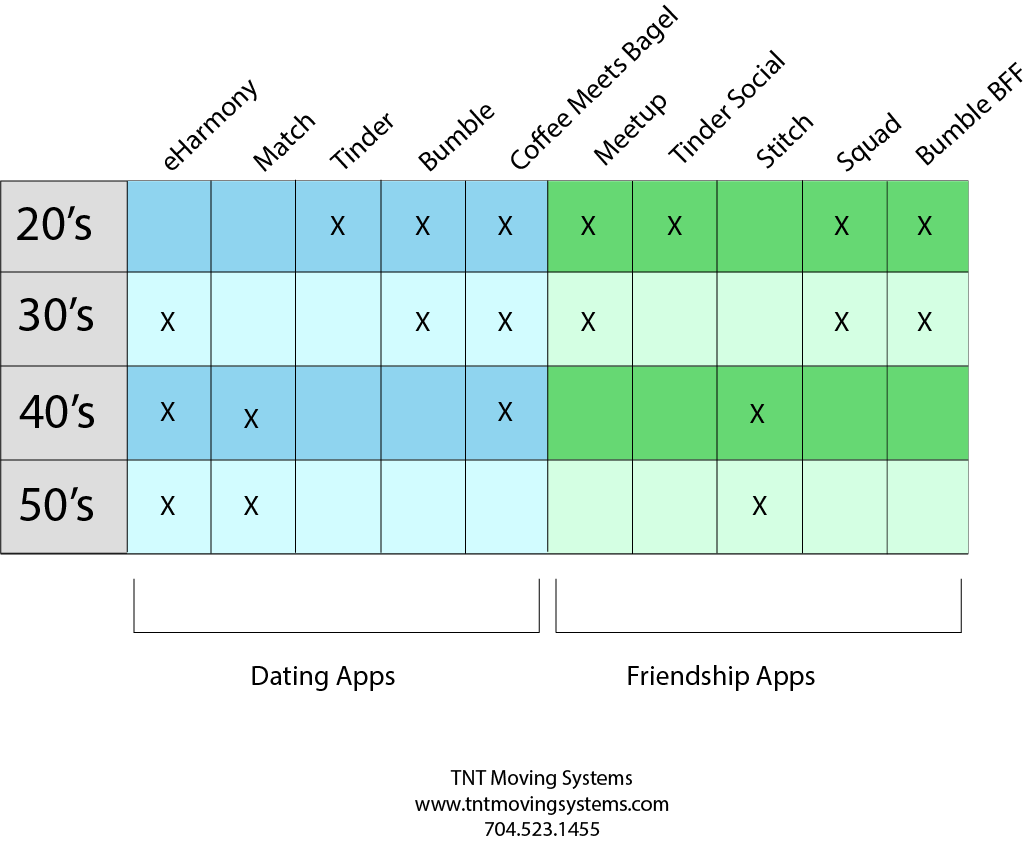
LApps to Meet New Peopleooking for a job? Moving to a new area provides new opportunities to network. Look online for meetup groups, update your Linkedin and any applicable social media platforms to indicate your new city and highlight your skill set. Check out temporary opportunities, part-time and seasonal employment while you look for your new position.
Throw a party! Invite your new neighbors for a drop by meet and greet. Maybe you don’t want strangers in your house, does your community have a pool or a club house? Perhaps there is a homeowners meeting or social event coming up.
Get schooled. If you have a child in school (or are in school yourself), coordinate study groups in your home (church groups too), invite your children’s classmates over for supervised playdates, or volunteer for your school or church.
Do you have a secret talent? Maybe you are a pet sitter, great with gardens, or are handy with a hammer. Check local regulations first and offer your services to your neighbors. This will open the conversation and perhaps help your fill your wallet.

DO WHAT YOU LOVE
Make your favorite comfort foods. Maybe you are from an area known for chili and you are suddenly in chowder territory. Make yourself a pot (and perhaps invite a new friend to share). The holidays also offer up a great chance to make your traditional treats and introduce them to others.
Continue your hobbies. Before the move, do some internet searching and find out where you can practice Thai chi, skeet shoot, or horseback ride near your new digs. Or, maybe actual digging is what you dig! Those amateur archaeologist skills could prove a handy way to volunteer and help introduce you to those who came before.
Did you enjoy decorating? You have a blank canvas and the perfect opportunity to create your new nest. Check out the local antiques and boutiques and combine regional items with those you brought along with you.
Are you a reader? Join a book club or maybe even start one in your neighborhood at home. You could use this opportunity to trade some books or try out local authors.
Invite friends and family to visit! Spending time with loved ones can go a long way in helping you feel confident in your new environment and it lends the opportunity to be a tourist and play tour guide in your new city. Invite new friends or co-workers to join in and explore together!
While moving as an adult and making new friends does have challenges, it can also open you up to experiences and friendships you may never have imagined!


*Martijn Hendriks, Kai Ludwigs, and Ruut Veenhoven, “Why are Locals Happier than Internal Migrants? The Role of Daily Life,” Social Indicators Research 125 (2016): 481–508.